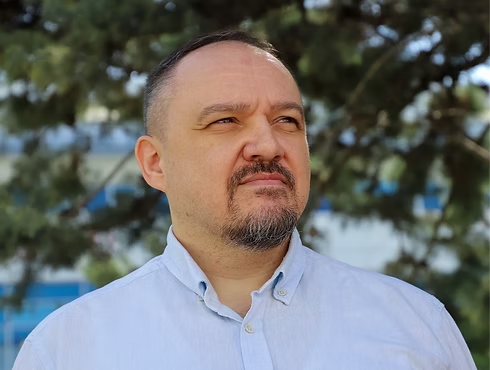
Prof. Dr. Oğuz Ergin
Our country is not out of options.
The campaign slogan in the original Turkish: Ülkemiz seçeneksiz değil.
I am a professor of computer engineering and an independent candidate for the Presidency of Turkey. I belong to no political party. Since March 2025 I have been trying to reach the ballot through the route the constitution provides for citizens, and I have been unable to, for reasons that are now the subject of proceedings before the European Court of Human Rights and the UN Human Rights Committee.
The Legal Case →
The full documented record: four procedural demands, two rejections by the Supreme Election Council, exhausted domestic remedies, and the pending international applications. With source documents.
About →
Academic and professional background: microprocessor architecture, memory security, the Kasırga laboratory, and why a computer engineer is standing for office.
The Programme →
Ten headings, each with a measurable target rather than a slogan. Published in Turkish, the language of the electorate it addresses.
What this campaign is
Turkey's constitution allows a citizen to stand for the presidency without a party, on condition that 100,000 voters sign in support. That right exists on paper. In practice the signatures must be given in person, at a district election board, within a window that has lasted five to six days, while a national digital identity system that could carry the process sits unused, and while roughly 3.4 million citizens living abroad have no way to take part at all.
I asked the Supreme Election Council to change four procedural details: to allow signatures through the existing e-Government platform, to extend the collection period to at least ninety days, to let citizens abroad sign at consulates, and to bring the non-refundable deposit of two million Turkish lira down to a proportionate level. None of these requests concerns me personally. Each of them would apply to any citizen who wished to stand.
The requests were refused. In its reasoned decision of 3 July 2025 the Council stated plainly that the power to extend the signature period belongs to the Council itself, and then declined to use it. The Constitutional Court held that it could not review the decision at all, because the constitution places the Council's acts outside judicial review. That is the point at which a domestic legal question became an international one.
Where the case stands. Applications were filed with the European Court of Human Rights and the UN Human Rights Committee on 15 September 2025 and are pending. A second application to the Supreme Election Council, filed the same day, has gone unanswered for more than seven months.
What I am proposing
The argument of the campaign is simple. Turkish politics has spent decades circling the same disputes, while the decisions that will settle the country's place in the coming century, in computing, energy, education and industrial capacity, go unmade. A country that produces its own processors, keeps its trained engineers, and appoints people to office on the basis of competence is not a fantasy. It is a matter of deciding to do it and then being held to measurable targets.
The programme is therefore written as ten headings with defined targets rather than promises, in three stages: repair the machinery of the state, then secure the country, then build what comes next. It is published in Turkish, because it is addressed to Turkish voters. An automatic translation will convey the substance well enough for readers who want the detail.
A note on this English section
This is a summary in three pages, not a translation of the whole site. The campaign is conducted in Turkish, and the full material, the programme, the complete legal archive, the supporter network and the campaign's own tools, is published at oguzergin.net.
These English pages exist so that journalists, researchers and human rights organisations working outside Turkey have an accurate, documented account of what has happened, in a language they can check.
Contact
Interviews are available in Turkish or English. Case documents, photographs and a full curriculum vitae can be provided on request.